Psychologists and therapists
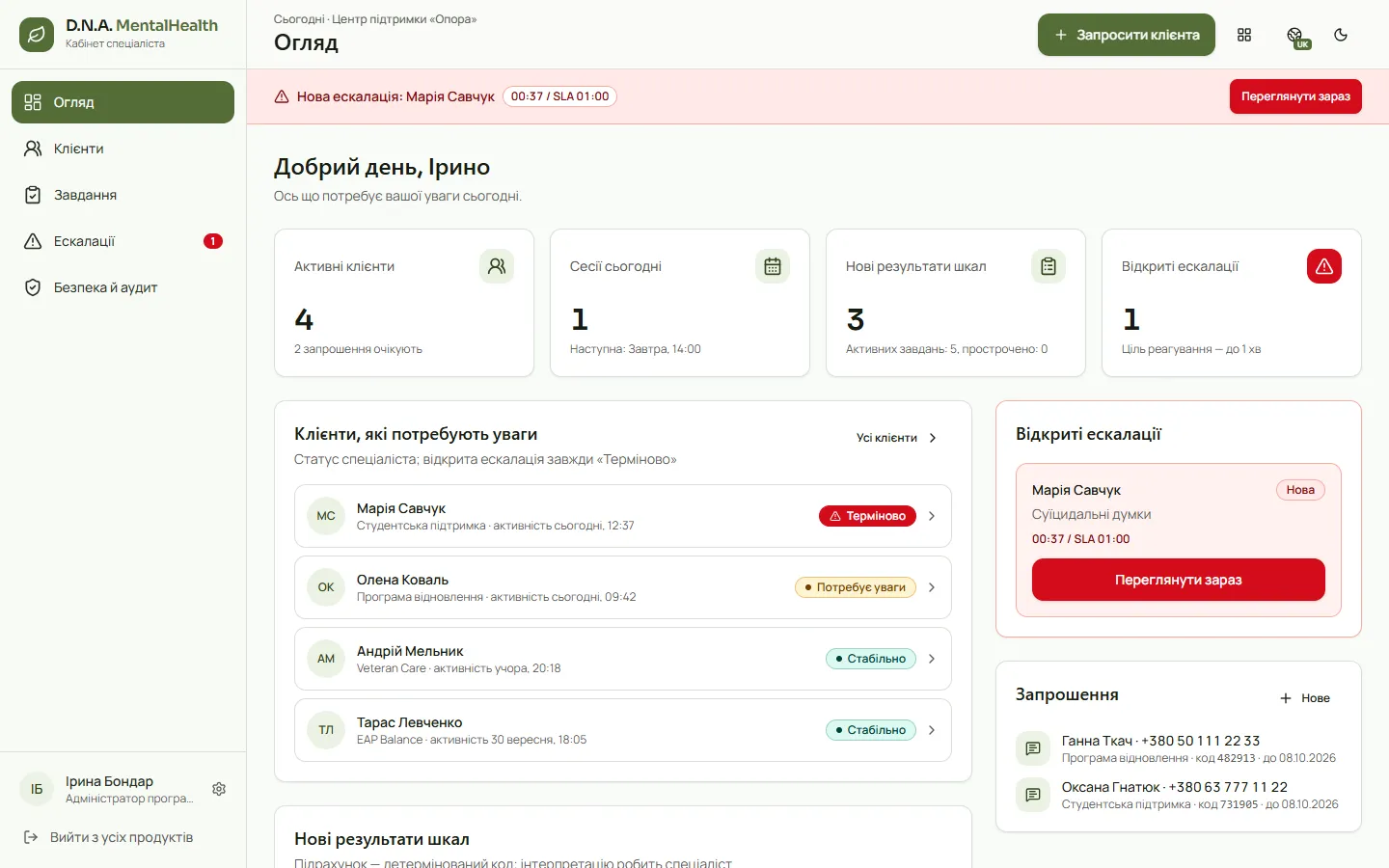
See how a client is doing between sessions, assign exercises and scales, and come to the session with facts rather than a week’s recollection.
For mental-health specialists and support programmes
Code-scored scales, a wellbeing diary, homework and a crisis protocol. Clients join only by your invitation; AI prepares drafts — the specialist decides.
Not an AI therapist and not an emergency service.
Who it’s for
Clients don’t sign up on their own: a specialist or programme invites them. Every client always has a person who sees how they are doing.
See how a client is doing between sessions, assign exercises and scales, and come to the session with facts rather than a week’s recollection.
One cabinet for the team, an on-call specialist for crisis signals, an action audit and granular client consents.
A programme with specialists, content and an on-call rota; donor reporting with aggregates only, no personal data.
Psychological support for employees through your EAP provider. The employer never sees who took part or what they wrote.
How it works
The client gets an SMS code, confirms the number and gives consents themselves. No invitation, no access.
A quick mood and sleep check-in, assigned scales and exercises. The AI helper guides steps only within the assigned exercise.
Scale scores, charts, triggers and homework. The specialist accepts, edits or rejects the AI weekly summary draft.
Rules stop the flow, show emergency numbers and alert the programme’s on-call specialist. Target: a response within 1 minute.
Features
Deterministic parts run as code, decisions stay with people. AI never diagnoses or prescribes.
| Feature | What the system does | What the specialist does |
|---|---|---|
| PHQ-9, GAD-7, PCL-5, ISI scales | Scores by code using the published keys; the PHQ-9 self-harm item triggers the crisis protocol | Assigns the scale, interprets the result, discusses it in session. The client doesn’t see scores |
| Wellbeing diary | Mood, sleep and trigger-frequency charts with a table view | Notices changes between sessions and sees the context |
| Homework | Templates: CBT thought record, 4–6 breathing, behavioural activation, grounding | Assigns and adapts the instructions, sees every client entry |
| AI helper in an exercise | Guides the assigned exercise and gives sourced psychoeducation; declines diagnoses, medication and off-topic requests | Turns the helper on for a specific exercise; the client separately consents to AI |
| AI weekly summary | A draft of facts from the client’s data with source links, no interpretation of state | Accepts, edits or rejects it; the decision is logged |
| Crisis protocol | Rule-based detector in the diary, exercises and chat; emergency numbers; escalation with a timer | The on-call specialist acknowledges, calls and resolves with a reason |
| Specialist cabinet | Clients and statuses, versioned notes, invitations, action audit | Runs clients and the programme; signs in via D.N.A. ID |
Scale sources: Kroenke, Spitzer, Williams, 2001 · PHQ-9 · Spitzer et al., 2006 · GAD-7 · Weathers et al., 2013 · PCL-5 (National Center for PTSD) · Bastien, Vallières, Morin, 2001 · ISI. Validated Ukrainian versions and the ISI licence are agreed with the clinical partner before the pilot.
Clinical oversight
A clinical partner approves exercises, psychoeducation, crisis scenarios and the detector’s evaluation set.
Every programme has an on-call specialist who receives crisis escalations.
Launch happens only after a pilot and the clinical partner’s readiness sign-off.
Site and app copy is agreed with the clinical partner before launch.
Safety and compliance
Specialists sign in via D.N.A. ID (SMS code and passkey or Diia.Signature); clients sign in with their phone on this site. The contexts never mix.
A separate protected D.N.A. Health Core environment; health data stays in UA / EU.
Health fields are encrypted with the organisation’s keys (DCP); access is scoped to the organisation.
Every action goes into a hash-chained log you can verify and export.
Participation, data processing, AI help, research — separately. Only the client gives consent and withdraws it in one tap.
Any AI output is a draft until the specialist confirms it; clients never see drafts.
Training on health data is off; possible only de-identified, by contract and with consent.
Pilot
We’ll publish results after the pilot — measured figures only, with participants’ consent.
Pricing
Draft pricing until the pilot ends; final terms are set in the contract.
$29 / specialist / mo
Contract
FAQ
No. It’s a specialist’s tool between sessions. A client only gets in by invitation from their specialist or programme, and every decision is made by a person.
No. The AI helper only guides the steps of an assigned exercise and explains why, with a source. Asked about a diagnosis or medication, it says that’s a question for the specialist. The AI summary is a draft of facts the specialist accepts, edits or rejects.
Rules detect danger signs in the diary, exercises and chat, and in PHQ-9 item 9. The flow stops, the client sees 103, 112 and the suicide-prevention line, and the programme’s on-call specialist gets an escalation with a response timer. A “Get help” button is on every client screen.
In the protected D.N.A. Health Core environment in Ukraine and the EU, with health fields encrypted under the organisation’s keys. A client is seen only by their specialist and the programme’s on-call specialist; an employer or donor gets aggregates only. Every action is written to the audit log.
The specialist sends an invitation to the client’s number. The client enters the invitation code and an SMS code sent to that number, then gives consents. After that they sign in with their phone and an SMS code.
Through D.N.A. ID — the single staff sign-in for D.N.A. Healthcare products: an SMS code and a passkey or Diia.Signature. The licence is checked once; your organisation’s admin grants access.
Leave a request below. We’ll discuss the programme format, clinical partner and on-call rota, then the pilot and contract. Grant funding is possible for NGOs.
Request
Tell us about yourself — we’ll get in touch to discuss the programme format, clinical partner and pilot.